Colour and pattern
Another of the interior design rules for your home is colour and pattern choice. Colour plays a big part in our homes. It can have a huge impact on our mood so it is essential to pick the colours that work for you and the space you are designing. Using pattern brings interest and texture as well as colour so it also plays an important role in making a room feel more though through and finished.
As an interior designer I appreciate colour is a very important part of the design process which shouldn’t be rushed. Ask yourself what feelings you need to have in a room you are decorating and see if the colours you have chosen make you feel that way. Try various testers on your walls. The colours change as the light outside does so don’t rush choosing a colour and test, test, test until you are 100% happy with your choice.
The colours that Geraldine Tan has used throughout her home (image above) are very happy and bright, is this the feeling you want to evoke? Or are you looking for a more pared back, neutral space? You can see that she has also used pattern very well, all of the cushions and artwork are different patterns but they all work together as they have a common colour theme. Geraldine’s lovely, colourful home can be seen on her blog here.
A lot of people play it safe with colour as they’re scared of getting it wrong, but if you’re using paint then it’s only a matter of painting over it so be bold and choose the colours that bring you joy. Whether that’s a soft calming beige or a bright and bold blue, you’re going to live with it!
One of the design rules…
One of the design rules you can use when adding colours to your room is the 60, 30, 10 rule: 60 for the largest space – probably the walls, 30 for a piece of large furniture and a rug and 10 for an accent. This doesn’t include patterns which should be made up of variations on that theme.
A neutral back drop can be enlivened with pops of colour and pattern, which can be easily switched out as seasons and trends pass by. Choosing colour is a big old topic, and one which I’m going to delve into further in other posts as I know it’s something that people struggle with. The best way to add interest if you feel that the room still feels a little “flat” after choosing your colour palette is to add a contrast accent that lifts everything around it.
Without getting too technical, this handy guide from Dulux which shows the different colour schemes and how to use a colour wheel. A colour wheel is a cheap and handy tool you can use to as a guide when starting your colour schemes.
Mirrors
Add mirrors to a small room to create the feeling of space. Adding a mirror to a dark room facing a window reflects the light back into the room. Have a play around and experiment what works for you.
Your room has to be comfortable
If there is ONLY one interior design rule you abide by it has to be never compromise style over comfort!! This is so important. Your room not only has too look good but work for you.
It goes back to the original planning and what you are using the space for.
Hang it it the right height!
A beautiful painting or artwork will look far better when hung at the right height. Also, having a consistent centre line throughout your home helps create a sense of harmony.
As a general interior design rule, the centre of the artwork should be at eye level, which for the average person is 145 centimetres from the floor. Remember, that’s 145 centimetres to the centre of the art, not to the hook!
Of course all interior design rules are made to be broken, so when it comes to a feature picture wall, well, anything goes.
A top tip is to centre the first piece – your statement artwork – at eye level and spread smaller pieces outwards from there. Search gallery wall on Pinterest for lots of ideas.
I hope you have found this guide useful on the interior design rules to consider when designing a room in your home. To summarise I have added this handy checklist:
- Do Space planning and plan your room layout
- Do take time to choose the right colour for your room
- Do Mix old and new pieces
- Do add a focal point
- Don’t mix woods
- Do add layered textures
- Do hang your artwork at the right height
- Do ensure your room is comfortable
- Don’t group accessories in two’s or four’s
- Do group in odd numbers
- Do add mirrors
- Do think about the height of your curtains
If you feel daunted about how to incorporate interior design rules when designing your own room then check out my other blogs, or Facebook and Instagram.
You could also join my free Facebook group, where I share handy tips and up to date industry information.
All the best
Angela


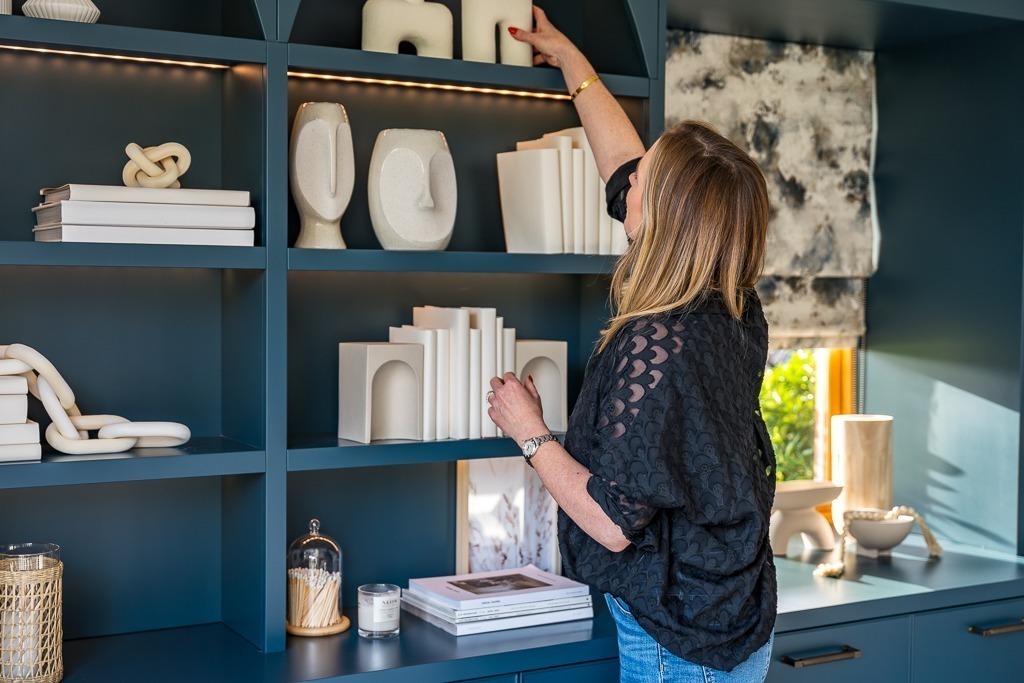
Interior design rules for your home – a handy guide
Designing your home can be daunting. There is so much to consider in ‘getting it right’!
Ask any interior designer about the secrets to styling a beautiful home and they’ll invariably say something along the lines of: “There are no rules to design”. There are however, some basic “ground rules” you can use to guide you in making your new room design a success.
As an interior designer, much of what I do is instinctive as I’ve done it for years, but my instincts are ground in basic “design rules” that work every time when planning any room scheme.
If you follow the basic rules of interior design then there won’t be any nasty shocks with clashing colours, oversized furniture or a room just not feeling like you thought it would.
So what are the interior design rules to consider in your home?
The design rules cover many different elements of interior design, the main ones I get asked for advice and assistance on are:
– Space planning
– Colour and Pattern
– What to think about when making a room feel cohesive and stylish
Space planning
One of the first things that should be considered when designing a room is the space- how large the room is, which direction does it face, when does it get the best light, where are windows and doors, do they need to be moved, etc.
Before you think about anything like colour and styling, your room has to function well. The space needs to be planned so that it flows and the furniture you add to the room is to scale.
As an interior designer I regularly visit clients where their home space isn’t working for them, they know it doesn’t feel “right” but they don’t know how to remedy it themselves. The space may have oversized furniture which makes the room feel smaller or they haven’t used the furniture they have to fill the space in a way that brings the cosiness you want in a family home.
This room is a prime example of the lack of space planning:
One of the common mistakes is to feel that furniture needs to sit against a wall. In a large room like this, it is almost impossible to have good social interaction when the furniture is so far apart. The TV is blocking one of the windows which is not ideal, and overall the space feels very cold as all of the textures are quite “hard” and shiny – the floor, leather furniture and glass and metal coffee table all feel a little unfriendly, there’s not much other texture apart from the soft furnishings. The lovely fireplace and log burner aren’t being made a feature, and the furniture is all too far away from the fire to feel any benefit from it!
Bringing the furniture around the fire is one of the main elements that completely transforms this room, as well as a gorgeous big rug to “anchor” everything together. Two sideboards create good symmetry and much needed storage, whilst a circular coffee table brings a softer element in its shape and texture than the previous coffee table did. A side table gives the armchair user somewhere to pop a drink or a book.
The difference from before and after is quite something, even though all of the upholstered furniture was already in place! You can see the room feels cosy, as the fireplace is much more of a feature. The room also flows well, you can easily walk around all of the furniture even though it has been grouped together much closer than it was before.
From this example, it’s easy to see why space planning is a fundamental element of the interior design process. It starts with an in-depth analysis of how the space is to be used, so if you’re doing this for yourself, have a really good think about what activities take place in your home.
What to consider when deciding on layout
Think about the structure of the room, what are the main focal points? These could be windows, fireplaces, doors or built in units. Are they balanced in the room? For example, if you have two doorways coming into the space, do you need both? A lounge room often has this problem, it can create a “corridor” feeling if you can’t place furniture to break up the walkway through the room.
If you are looking to block off doors, ensure that the room still allows for an easy and economic pathway from the door to all the other main activity areas.
Think about..
the space in terms of scale. A small room will feel claustrophobic with pieces of furniture that are too large or dominant. Plan your furniture with a scale drawing of your room or cut paper shapes to size and place them in the room to work out the best possible arrangement of furniture and accessories.
Once you have really thought about the layout you would then draw up a plan that defines the zones of the space and the activities that will take place in those zones. The space plan will also define the circulation patterns, this means how people will move through the space, also called “the flow” (very important to a room feeling right).
If you’d like more information and advice on space planning, you can download my free guide here which will show you how to effectively space plan your room like a professional.
Colour and pattern
Another of the interior design rules for your home is colour and pattern choice. Colour plays a big part in our homes. It can have a huge impact on our mood so it is essential to pick the colours that work for you and the space you are designing. Using pattern brings interest and texture as well as colour so it also plays an important role in making a room feel more though through and finished.
As an interior designer I appreciate colour is a very important part of the design process which shouldn’t be rushed. Ask yourself what feelings you need to have in a room you are decorating and see if the colours you have chosen make you feel that way. Try various testers on your walls. The colours change as the light outside does so don’t rush choosing a colour and test, test, test until you are 100% happy with your choice.
The colours that Geraldine Tan has used throughout her home (image above) are very happy and bright, is this the feeling you want to evoke? Or are you looking for a more pared back, neutral space? You can see that she has also used pattern very well, all of the cushions and artwork are different patterns but they all work together as they have a common colour theme. Geraldine’s lovely, colourful home can be seen on her blog here.
A lot of people play it safe with colour as they’re scared of getting it wrong, but if you’re using paint then it’s only a matter of painting over it so be bold and choose the colours that bring you joy. Whether that’s a soft calming beige or a bright and bold blue, you’re going to live with it!
One of the design rules…
One of the design rules you can use when adding colours to your room is the 60, 30, 10 rule: 60 for the largest space – probably the walls, 30 for a piece of large furniture and a rug and 10 for an accent. This doesn’t include patterns which should be made up of variations on that theme.
A neutral back drop can be enlivened with pops of colour and pattern, which can be easily switched out as seasons and trends pass by. Choosing colour is a big old topic, and one which I’m going to delve into further in other posts as I know it’s something that people struggle with. The best way to add interest if you feel that the room still feels a little “flat” after choosing your colour palette is to add a contrast accent that lifts everything around it.
Without getting too technical, this handy guide from Dulux which shows the different colour schemes and how to use a colour wheel. A colour wheel is a cheap and handy tool you can use to as a guide when starting your colour schemes.
The handy guide on the Dulux website describes the different colour schemes in more detail, covering monochromatic, complementary, split complementary, contrasting and triadic.
If you would like to read about the latest colour trends for 2022, read our other blog post here.
If you’d like to delve deeper into the world of colour and colour psychology, then check out brilliant book “The Little Book of Colour: How to Use the Psychology of Colour to Transform Your Life” by the author and colour expert Karen Haller.
The Amazon link is here.
Add something old and something new to your room design
So, you’ve got your space plan sorted and you’re confident with colour, but what other interior design rules could you consider? Well, it’s not a rule per se, but I think every room looks better with something vintage or antique in it. Mixing styles and eras always creates an edited, well-collected, and curated look.
Your home has more than likely got some sentimental items that have been in the extended family and passed down, or old pieces that you have had in your own family which evoke memories. You should try and incorporate these where you can. In rooms primarily furnished with new items, bringing in older pieces instantly adds soul and depth. This could be anything from an antique textile pillow to a vintage chest, or an antique chair.
Add a hero piece
Another interior design rule that is one worth considering is that every room needs one hero piece. This is an item that will surprise and make an impact. It might be an oversized piece of furniture in a bold colour, a fabulous rug, a work of art, or a feature wall.
Your hero piece is designed to steal the limelight. It should be the thing you fell in love with the moment you saw it, and that you might be prepared to splurge a little more on. Remember, however, to make sure it has space to breathe.
Find your focal point
Another interior design rule is to give your room a focal point. It is the “thing” your eyes land when entering a space. Think fireplace, window, bespoke cabinetry. A room should always be designed and centred around at least one focal point that helps to guide your furniture placement and draw your eye.
When considering a living room, typically, a focal point faces the main entrance. Another good to know, while an area’s focal point usually dictates furniture placement, your seating arrangement does not have to face it. Also, some spaces have more than one focal point.
Here, designer Jenn Feldman has created a focal point whilst looking to disguise the large TV in the process. The cabinetry around the TV draws the eye away from it and onto the objects and books on the shelves.
Anchor your room
A rug is the one thing I frequently note is missing from my clients’ homes, which means they’re usually high on my list of items to purchase as part of a restyle. Why? Because rugs help anchor a room, plus they’re a great way to add colour, texture and softness. If you need to carve up a large, open-plan space into separate zones then a rug is your number-one tool.
Rugs are also relatively inexpensive for the impact they create. They can be changed easily adding different colours, without doing a full room redesign. Size matters! Be generous with the size of your rug. Remember the on-the-rug rule for your living room: go bigger to ensure that at least two legs of every furniture piece in the living area are sitting on the rug.
Make sure the rug extends at least 15 to 25 centimetres from either side of the sofa to create a balanced look.
And remember, a rug is not wall-to-wall carpet – never lay a rug right up against the wall or window. Aim to leave at least 25 centimetres of visible floor around a rug.
Mix up shapes, textures and materials
Most living rooms will have a lot of rectangles and squares – it’s simply the nature of those bigger furniture items such as sofas, sideboards and shelving units. If you notice your space has lots of lines and right angles, think about adding some circles. An interior design rule is to introduce a mix of shapes as well as textures as this image shows really well. A round coffee table, a pair of round side tables, even a round rug – the options are endless.
Curved furniture is huge at the moment and we are seeing more and more options available at prices which are more affordable then they once were. For further inspiration on curved furniture check out my other blog here.
Top Tip: A round mirror is a great way to break up all those straight tile lines in a bathroom. Go as big as you can. Large-scale mirrors make a real statement and can visually enhance the sense of space in a small bathroom too.
Take advantage of texture
Whether one is going with a more colourful space or a more tonal space, texture makes everything more dynamic and add interest to a space giving it character. Adding layers of texture to a room can change the whole feel from cold to warm and cosy.
Mix your metals
If you’re feeling nervous about mixing materials be rest assured that metals can and should always be mixed together. Too much of any one metal or finish is overkill, so it’s the blend of a few that creates balance and texture.
Stick to one wood
One of the interior design rules that it’s worth following is to just use one wood finish in a room. Even if a wood finish appears to be ‘close enough’ to another one being used in the same room, it will be very obvious when the two don’t match. The room will feel off so try to avoid this
Defy gravity with your curtains
This is a great interior design rule to use. If you’re looking to increase the height of your room visually, hang your curtains close to the ceiling, it just makes your room look taller. Similarly, if you want a window to appear bigger in width add a longer curtain pole to sit either side of the window and opt for a wider curtain.
Grouping – an important rule in interior design
Another common mistake is not forming groups with interior accessories, or furniture. It is important to create groupings where size and shape mimic each other, creating an integrated look. This also goes for furniture. The rooms visual height and scale can be adjusted with other various-sized objects, but furniture should be similar in size/scale/shape when grouped together.
Always apply the rule of three or five when grouping accessories. Odd numbers of objects usually look so much better visually than even numbers grouped together.
Mirrors
Add mirrors to a small room to create the feeling of space. Adding a mirror to a dark room facing a window reflects the light back into the room. Have a play around and experiment what works for you.
Your room has to be comfortable
If there is ONLY one interior design rule you abide by it has to be never compromise style over comfort!! This is so important. Your room not only has too look good but work for you.
It goes back to the original planning and what you are using the space for.
Hang it it the right height!
A beautiful painting or artwork will look far better when hung at the right height. Also, having a consistent centre line throughout your home helps create a sense of harmony.
As a general interior design rule, the centre of the artwork should be at eye level, which for the average person is 145 centimetres from the floor. Remember, that’s 145 centimetres to the centre of the art, not to the hook!
Of course all interior design rules are made to be broken, so when it comes to a feature picture wall, well, anything goes.
A top tip is to centre the first piece – your statement artwork – at eye level and spread smaller pieces outwards from there. Search gallery wall on Pinterest for lots of ideas.
I hope you have found this guide useful on the interior design rules to consider when designing a room in your home. To summarise I have added this handy checklist:
If you feel daunted about how to incorporate interior design rules when designing your own room then check out my other blogs, or Facebook and Instagram.
You could also join my free Facebook group, where I share handy tips and up to date industry information.
All the best
Angela